Black History Month: Spotlighting Black Leaders in Greensboro
 Community Foundation of Greater Greensboro
on
February 18, 2026
Community Foundation of Greater Greensboro
on
February 18, 2026
This Black History Month, the Community Foundation of Greater Greensboro is proud to spotlight the voices of Black leaders serving on our Board. Their leadership shapes our work in meaningful ways, guiding how we invest in community, advance opportunity, and steward philanthropy across our region. Through their reflections, we honor the legacy of those who paved the way while recognizing the ongoing responsibility to build a more equitable and inclusive future for Greensboro.
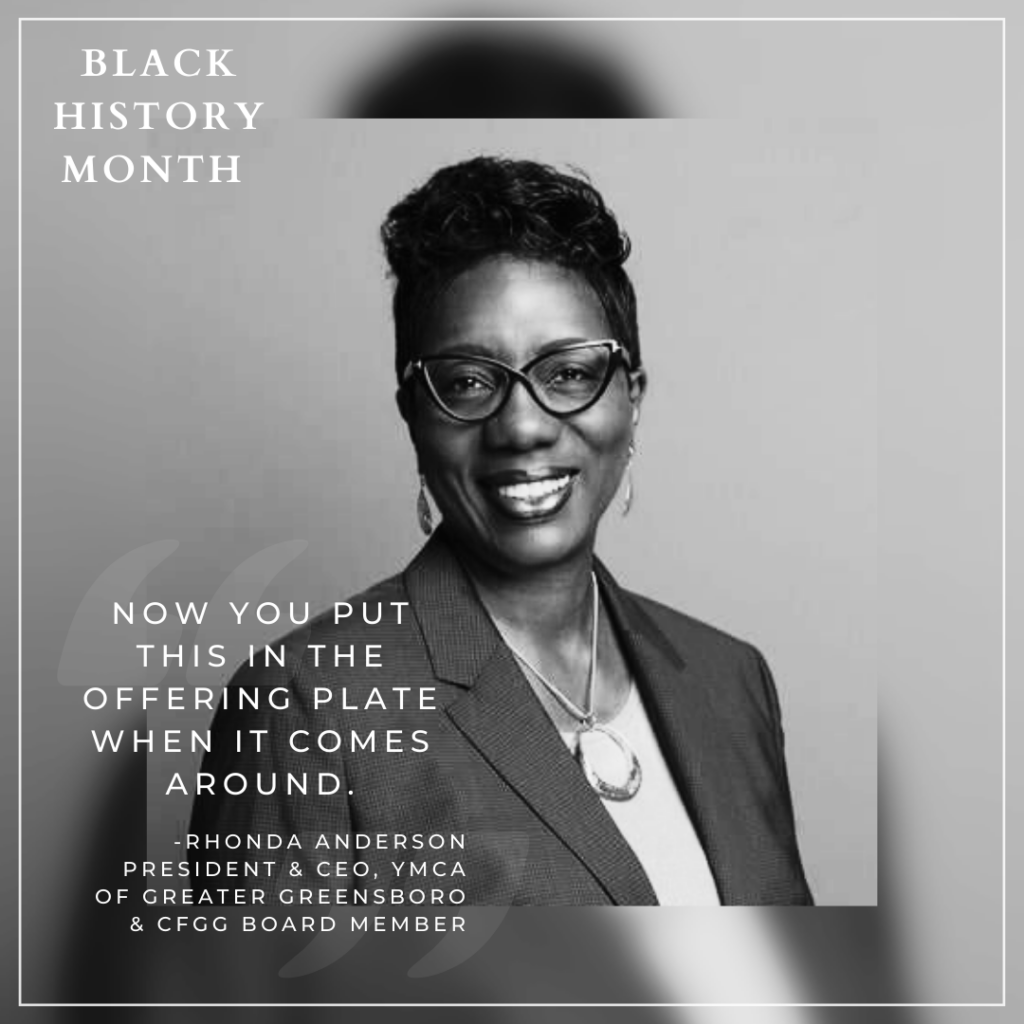
Rhonda Anderson
President & CEO, YMCA of Greater Greensboro, CFGG Board Member
Q: Who is a Black leader—past or present—who has inspired your approach to service and philanthropy, and why?
A: Every Sunday at church, she would press a nickel into our tiny hands and say, “Now you put this in the offering plate when it comes around.” At the time, I had no idea the lesson my late maternal grandmother was teaching my sister and me. Though she never went beyond the sixth grade in a formal classroom, she held the equivalent of a PhD in generosity and service.
From an early age, she planted the seeds of giving and service in each of her grandchildren. A slice of her homemade pound cake and a glass of sweet tea were often the reward for anyone who stopped by to “visit for a spell.” Her home was simple, but her welcome was always abundant.
She may not have had much in the way of material wealth, yet she was unwavering in her belief that there was always room to make provision for others, whether that meant giving to the church, preparing a meal for someone in need, caring for five rambunctious grandchildren during the long summer days, or quietly setting aside a portion of the little she had.
My grandmother left an indelible impression that shaped the way I give of my time, talents, and treasures. She modeled a way of life I have carried with me ever since: that giving and serving are acts of faith, asked of us no matter how much or how little we have. She was and continues to be my truest inspiration for service and philanthropy.
Q: How do you balance honoring the legacy of past Black leaders while creating space for new voices and ideas in philanthropy?
A: Alex Haley is often credited with the proverb, “If you see a turtle on top of a fence post, you know it didn’t get there by itself.” That truth resonates deeply with me. As leaders, we are called to honor and give thanks for those whose shoulders we stand upon, those who prayed, persevered, and sacrificed long before we ever arrived. It is because of their faith, their resilience, and their unwavering commitment that we are able to move the work forward today.
The late Joe Madison once reminded us, “I will not pass you my torch, but I will light yours.” That wisdom speaks to the sacred responsibility of legacy. There should be no competition between those who paved the way and those who now walk the path, only deep appreciation for the foundation that was laid and faithful hope for what is still to come. We are not replacing the past; we are carrying it forward, guided by grace and strengthened by those who came before us.
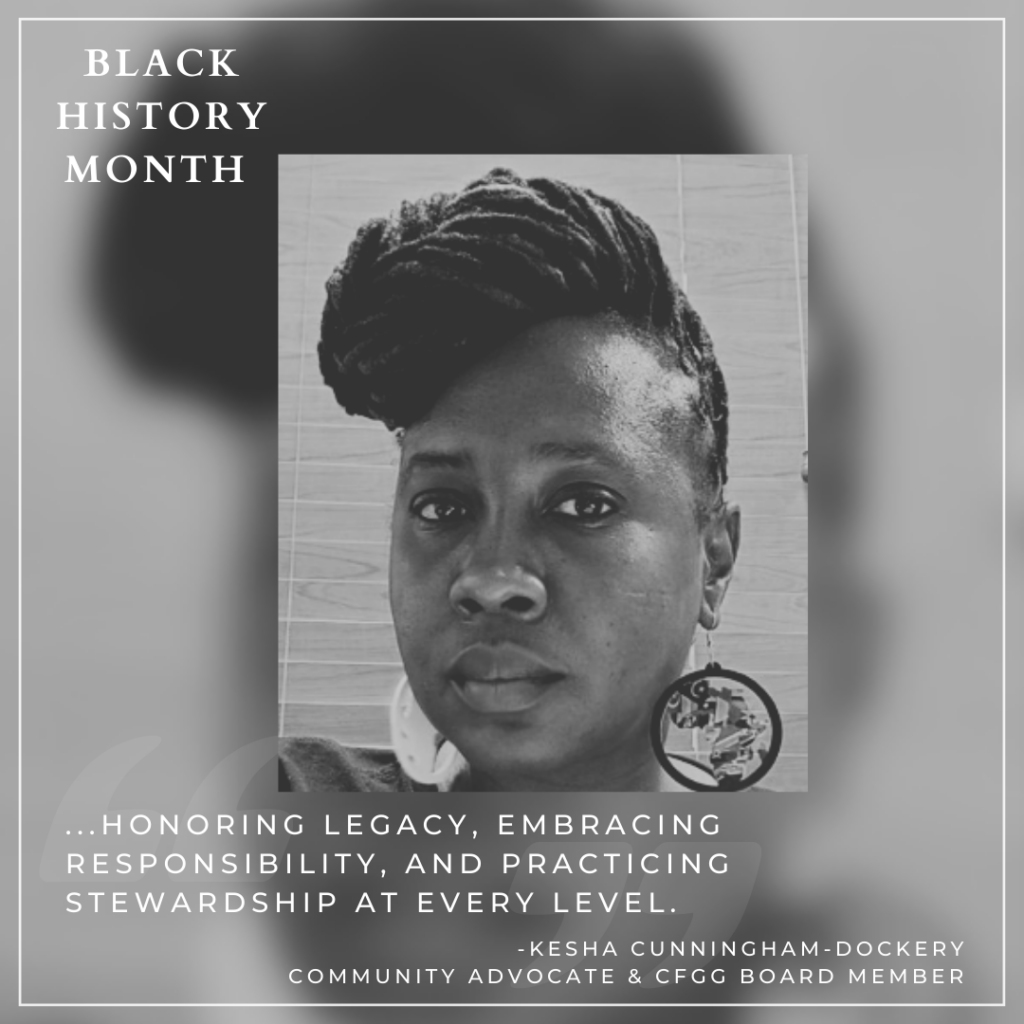
Kesha Cunningham-Dockery
Community Advocate, CFGG Board Member
Q: What does Black History Month mean to you personally, and how does it influence the way you show up as a leader in Greensboro?
A: As a child, I often wondered why we needed a designated “1-month” reminder about the invaluable contributions of Blacks in our communities to this country. We knew what we had done. Despite facing adversity, we’ve persevered and continued to invest in a nation that historically hasn’t always invested in us. To me, Black History Month is about honoring legacy, embracing responsibility, and practicing stewardship at every level.
Legacy is personal—I stand as a community advocate in Greensboro, grounded by the hard work of my grandparents, who were sharecroppers and railroad workers. Those ancestors dreamed of the opportunities I now have, fought for dignity, and a chance to live in a place like Greensboro. Many of the bravest moments in our collective story happened because ordinary people found the courage to speak out, even when they were afraid.
Responsibility is ever-present; each day, while we continue to make history. The choices we make about affordable housing, parks and recreation, economic opportunity, and the distribution of community resources shape everyone’s future, especially for families long excluded from these conversations.
Stewardship is essential, especially now when topics around DEI and Black history encounter resistance or distortion. My approach to leadership is intentional—I always aim to act with honesty and awareness because my decisions impact others. It’s vital to elevate every voice in Greensboro, particularly those who have been historically marginalized, and to lead transparently with clear values. I strive to remain resilient, building bridges and refusing to let differences weaken my dedication to fostering community and creating spaces where truth and unity thrive together.
Q: Who is a Black leader—past or present—who has inspired your approach to service and philanthropy, and why?
A: Fannie Lou Hamer is a key inspiration for my views on service and philanthropy. Her example shows that leadership doesn’t require power or positions. She served her community with courage, faith, and dedication, starting as a sharecropper. By co-founding the Freedom Farm Cooperative, she promoted economic independence and dignity, demonstrating that true service means creating lasting change rather than offering short-term help. Her approach reminds me that philanthropy should address underlying systems and requires persistent courage and compassion. Hamer’s legacy of servant leadership continues to shape my perspective today.
Q: How do you see the role of philanthropy in preserving and advancing Black history and culture in the Greensboro community?
A: It is well understood that financial resources drive progress. However, philanthropy extends beyond simply making donations; it involves continued strategic organization, cultivating relationships, and engaging in efforts to ensure that Black History is recognized not merely as a commemorative occasion but as an essential component for ongoing policy development, investment, and community advancement. Greensboro possesses a significant Black and civil rights legacy. It is important to honor the past, support current initiatives, and invest in the future through all appropriate means.

Sharon Dooley
DEIB Strategic Business Consultant, Dooley Consulting, CFGG Board Member
Q: What does Black History Month mean to you personally, and how does it influence the way you show up as a leader in Greensboro?
A: Black History Month is deeply personal to me. As a Black woman, Human Resources and Organization Development consultant, social justice advocate, and long-time volunteer, donor, and board member, it represents both reflection and responsibility. It reminds me of the sacrifices, resilience, courage, brilliance, and contributions of those who came before me/us. As I reflect on the many opportunities that were created when and where none existed and the pathways that evolved despite barriers, it reinforces my commitment to service, equity, and community impact.
It influences how I show up as a leader in Greensboro and beyond by reminding me that representation matters. Especially in today’s climate, where many of us feel a growing sense of division and, at times, concern about the preservation of our collective history and identity, Black History Month becomes even more significant. It reminds me that showing up as a leader means being intentional about inclusion, ensuring voices are heard, advocating for fairness, and helping create spaces where all members of our Greensboro community feel valued, respected, and represented. My goal has always been to not only have a seat at the table, but to help ensure more tables are built where everyone feels seen, heard, and valued.
Q: How do you balance honoring the legacy of past Black leaders while creating space for new voices and ideas in philanthropy?
A: Philanthropy plays a vital role in preserving and advancing Black history and culture in our community. It allows us not only to honor the past but to actively invest in the future by supporting cultural institutions, education initiatives, leadership development, scholarships, and community programs that keep history alive while empowering new generations. We must foster innovation. Thoughtful philanthropy helps ensure that stories are told fully and accurately, that communities have access to opportunity, and that equity remains central to our work. When philanthropy intentionally invests in equity, it helps ensure that Black history is not just remembered during one month of the year but is continuously uplifted through programming, leadership development, scholarships, and community initiatives.
For me, philanthropy is both an investment in legacy work and a commitment to forward movement for our future generations. It is about protecting history, amplifying voices, strengthening community connections, and helping build a future where opportunity, belonging, and dignity are accessible to all. Ensuring that the richness of Black history, culture, and possibility continues to thrive in Greensboro.
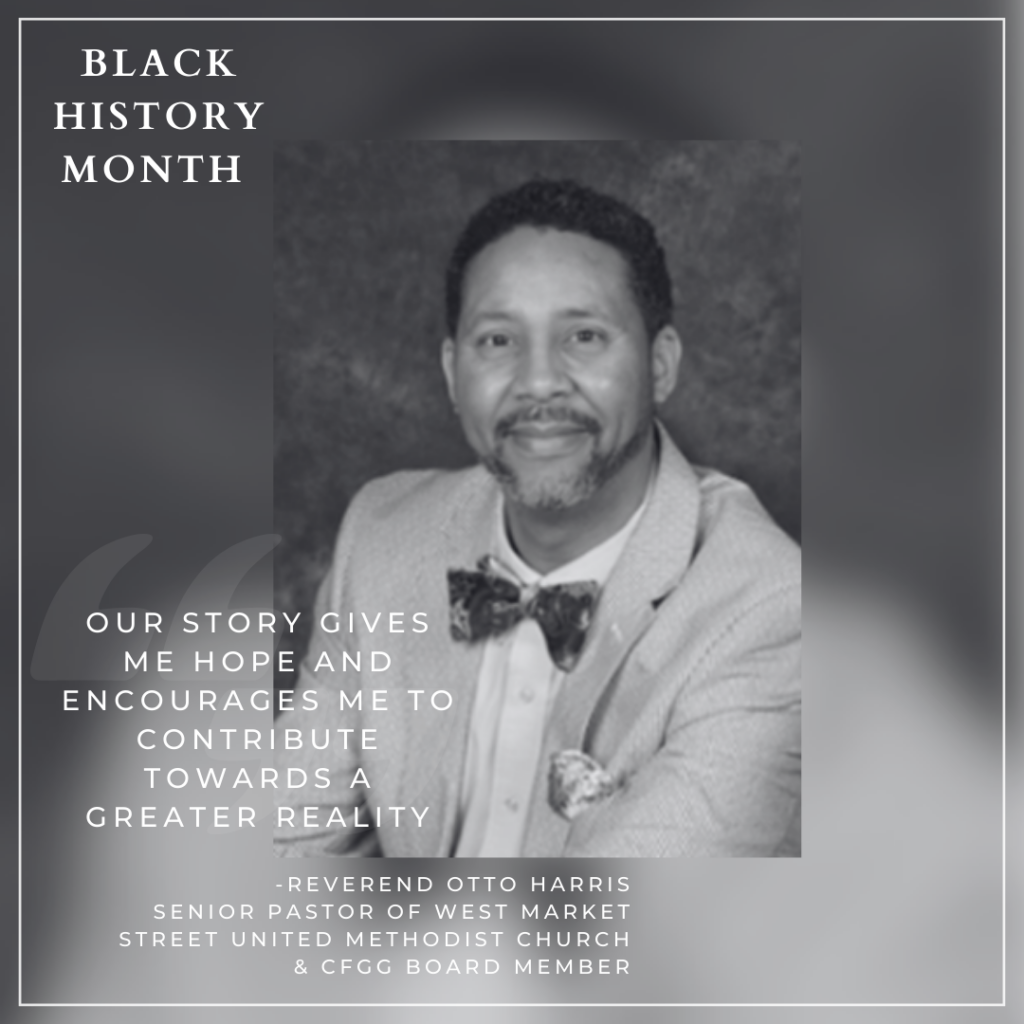
Reverend Otto Harris
Senior Pastor of West Market Street United Methodist Church, CFGG Board Member
Q: What does Black History Month mean to you personally, and how does it influence the way you show up as a leader in Greensboro?
A: Black History is the history of every U.S. American person. It is our story of radical dignity, ingenuity, resilience, and grace. As we remember our story, we are reminded of people who knew that there was a reality greater than their immediate struggle. Out of the hope for this greater reality, they lifted one another up and gave while they did not have a lot to give. Our story gives me hope and encourages me to contribute towards a greater reality that is unfolding all around us.
Q: How do you see the role of philanthropy in preserving and advancing Black history and culture in the Greensboro community?
A: Philanthropy disrupts the potential erasure of our inspiring story through intentional efforts or non-conscious disregard. Through philanthropy, we can keep our stories before us, remind ourselves of how we arrived where we are, and make investments towards progressing our community even further.
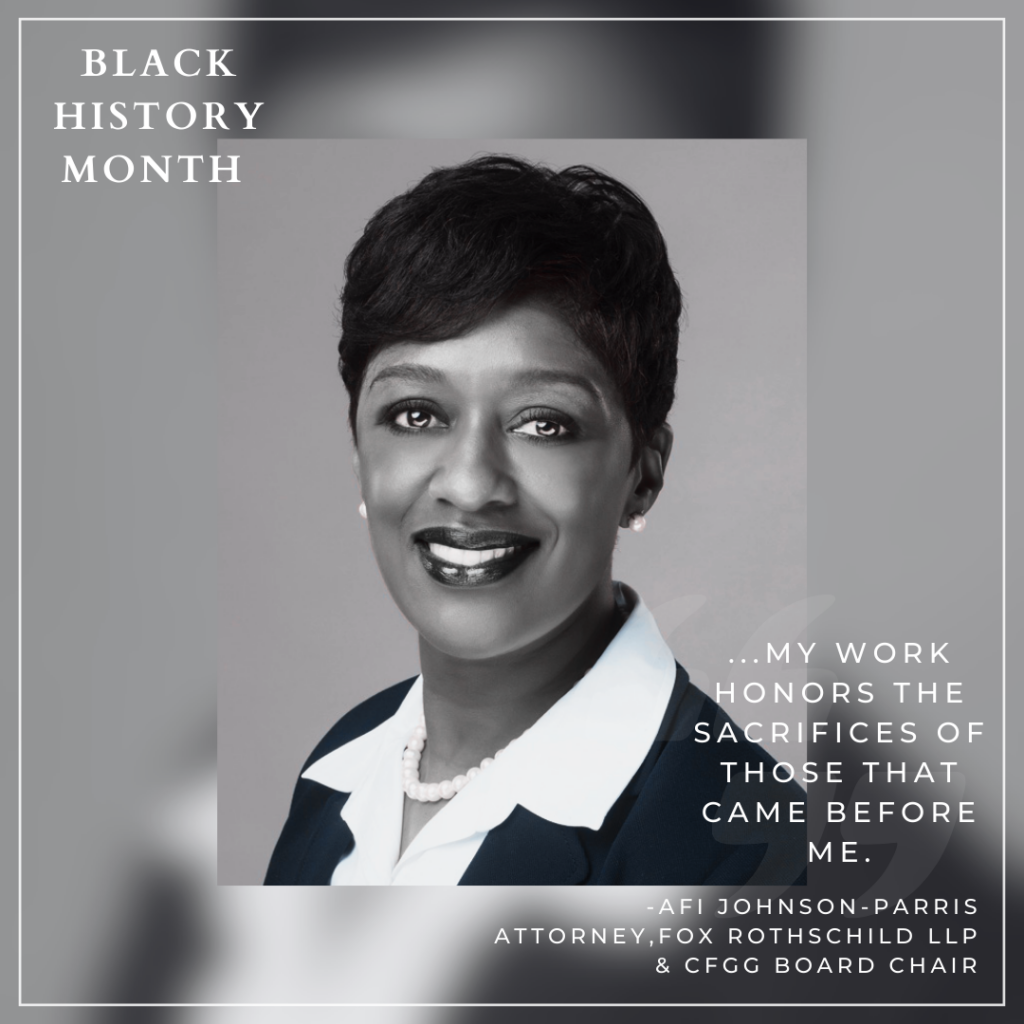
Afi Johnson-Parris
Attorney, Fox Rothschild LLP, CFGG Board Chair
Q: Who is a Black leader—past or present—who has inspired your approach to service and philanthropy, and why?
A: I greatly admire my friend Kim Bullock Gatling who is a leader within the Greensboro community. She balances career and family and still makes time to give back to institutions that are important to the Greensboro community like NC A&T, the Cone Health Foundation, and the United Way. Her leadership is always steady, yet transformative, and she is inclusive of a broad spectrum of people and perspectives. I seek her advice and use her example to say yes to opportunities to be of service to my community and to be mindful of ways to bring equity and inclusion to that service.
Q: What does Black History Month mean to you personally, and how does it influence the way you show up as a leader in Greensboro?
A: Black History Month means an opportunity to reflect on how far we’ve come and to notice how regular people doing extraordinary things can make a big difference. As I serve in leadership roles in Greensboro, I recognize that the small things that regular people like me do today can benefit the Greensboro of tomorrow. I know that my work honors the sacrifices of those that came before me.

Marissa Benton-Brown
Retired District Administrator, Guilford County Schools & CFGG Board Member
Q: Who is a Black leader—past or present—who has inspired your approach to service and philanthropy, and why?
A: A Black leader who profoundly inspired my approach to service and philanthropy was my maternal grandmother, Mrs. Clara Bell Thompson. While she may not have held a formal title, she was undeniably a leader in our family, our church, and our community. She led through action, compassion, and an unwavering commitment to helping others.
As my grandmother raised me, she made sure that church and community were central parts of our lives. Whenever there was a need, whether in the congregation or the neighborhood, my grandmother found a way to meet it. If someone needed help at home, she sent me to assist. If there was a financial need, she along with her sisters, organized bake sales, yard sales or fish fries and somehow always raised more than enough. At the time, I did not fully understand, but as I grew older, I realized that through her daily actions, she was teaching me that service is a responsibility and giving is simply part of living.
Her example shaped who I am as a parent, an educator, and a community servant. The principles she lived by continued to guide me, and I strive to pass them on to others. Serving as a board member of the Community Foundation has allowed me to honor her legacy by contributing to the well-being of my entire community.
Q: How do you balance honoring the legacy of past Black leaders while creating space for new voices and ideas in philanthropy?
A: I balance honoring the legacy of past black leaders by acknowledging programs, ideas, and opportunities they created for me, my family, and my community. Their work gives me a foundation to build on. I reflect on what went well and what could be improved, and I use those lessons to guide my own approach to service and philanthropy.
At the same time, that creates space for new voices by encouraging exploration, creativity, and fresh ways of doing things. Listening to new ideas helps us avoid repeating past mistakes and opens the door to innovative solutions that strengthen our communities. My very presence in this work is the result of someone’s vision for new voices and new leadership, so I feel a responsibility to keep that door open for others.
Honoring the past while welcoming new ideas allows us to bring the aspirations of previous generations into reality today. When we make room for diverse perspectives, we create healthier, stronger communities shaped by both legacy and innovation.
- Category: Uncategorized